Simhastha Kumbh Mela · Nashik–Trimbakeshwar

Your Complete Kumbh Guide

Snan dates, ghats, ritual timings, Akharas, history and the religious significance of the Nashik Kumbh Mela — researched and kept accurate for your pilgrimage planning.

--
Days
--
Hours
--
Minutes
Until the First Shahi Snan — 2 August 2027

Snan Dates & Ghats

The Nashik–Trimbakeshwar Simhastha Kumbh Mela unfolds across two sacred sites — Ramkund in Nashik for Vaishnava pilgrims, and Kushavarta Kund at Trimbakeshwar for Shaiva Akharas. The dates below are the currently published schedule; treat them as planning guidance and confirm closer to the date via official channels.

The Simhastha Dhwajarohan (flag-hoisting ceremony) at Ramkund on 31 Oct 2026, 12:02 PM, formally opens the Kumbh period. Overall Kumbh period: 31 October 2026 – 24 July 2028.
2 August 2027
First Shahi Snan
Shravan Shuddha — marks the formal opening of the principal bathing phase.
31 August 2027
Second Shahi Snan (Main / Amrit Snan)
Shravan Amavasya — regarded as the most spiritually potent bathing day of the Mela.
11 September 2027
Third Shahi Snan
Bhadrapada Shukla Ekadashi.
Ramkund
Ramkund, Nashik — Wikimedia Commons
Vaishnava
Ramkund
📍 Panchavati, Nashik
The most revered bathing ghat in Nashik, believed to be where Lord Rama himself bathed during his exile. Serves as the designated Shahi Snan spot for Vaishnavite sadhus, and is used year-round by pilgrims for holy dips and Shraddh rituals.
Kushavarta Kund
Photo: Michael T Balonek / Wikimedia Commons, CC BY-SA 4.0
Shaiva
Kushavarta Kund
📍 Trimbakeshwar
The bathing site for Shaiva Akharas, located at the symbolic source of the Godavari river, right beside the Trimbakeshwar Jyotirlinga temple — one of the twelve Jyotirlingas in India.
Godavari Ghat & 40+ sacred points
Trimbakeshwar Shiva Temple shikhara — Photo: Debapriya Hore / Wikimedia Commons, CC BY-SA 4.0
General
Godavari Ghat & 40+ sacred points
📍 Along the Godavari, Nashik
Beyond Ramkund and Kushavarta Kund, the Godavari's banks through Nashik carry over 40 recognised sacred points where rituals, poojas, and smaller snans take place throughout the Mela period.

Ritual Timings

Beyond the three major Shahi Snan dates, Nashik's ghats follow a daily rhythm of ritual and prayer that continues throughout the year and intensifies during the Mela.

Daily, 7:00 PM – 8:00 PM
Godavari (Goda) Aarti
An hour-long evening aarti at Ramkund/Panchavati — large lamps and bells on the riverbank, symbolising purification of mind and soul. One of Nashik's signature spiritual experiences for visitors.
Daily, 4:00 AM – 6:00 AM
Brahma Muhurta bathing window
The traditionally auspicious pre-dawn hours — the quietest, least crowded time for a holy dip, before the day's crowds build.
Daily, 6:00 AM – 6:00 PM
Purohit (priest) availability for rituals
Local priests at Ramkund are available through the day to assist with Shraddh and other personal rituals.

Akhara Information

An Akhara is a monastic institution uniting sadhus (ascetics) under a shared spiritual tradition and discipline — centres of learning, spirituality, and governance for their members. Thirteen principal akharas take part in the Kumbh Mela, grouped into three traditions, and their processions lead the Shahi Snan.

Naga Sadhu at Kumbh Mela
Naga Sadhu at a Kumbh Mela — Photo: Michael T Balonek / Wikimedia Commons, CC BY-SA 4.0
Naga Sadhu at Kumbh Mela
A Naga Sadhu blesses a pilgrim at a Kumbh Mela — Photo: Michael T Balonek / Wikimedia Commons, CC BY-SA 4.0

General Kumbh Mela sadhu photography shown below — these images are not attributed to any one specific Akhara (no reliable public source identifies photos by individual Akhara), but illustrate the sadhus who take part across all traditions.

Devotees of Lord Shiva
Shaiva Akharas
Juna Akhara (one of the largest, known for strict discipline and many Naga sadhus), Maha Nirvani, Niranjani, Atal, Avahan, Agni, Anand Akhara.
Devotees of Lord Vishnu
Vaishnava Akharas
Nirmohi Akhara, Digambar Akhara, Nirvani Akhara.
Blend Hindu and Sikh teachings, emphasising a detached way of life
Udasin Akharas
Bada Udasin Akhara, Naya Udasin Akhara, Nirmal Akhara.

History of Kumbh Mela in Nashik

The Kumbh Mela's origin lies in the Samudra Manthan — the mythical churning of the cosmic ocean — and its recorded history stretches back over a thousand years.

Sita Gufa, Nashik
Sita Gufa, Nashik — a cave linked to the Ramayana, part of Nashik's ancient religious history — Photo: Akshatha Inamdar / Wikimedia Commons, CC BY-SA 4.0

According to Hindu mythology, gods and demons together churned the Ksheera Sagara (ocean of milk) in search of Amrit, the nectar of immortality. When the Kumbh (pitcher) of Amrit finally appeared, a fierce celestial struggle broke out over it, during which drops of the nectar fell at four places on Earth: Haridwar, Prayagraj, Ujjain, and Nashik. This is why the Kumbh Mela rotates between exactly these four cities, roughly every three years in sequence, returning to each city every twelve years — Nashik's is known as the Simhastha Kumbh Mela.

The earliest recorded evidence of a Kumbh-like mass gathering comes from the Chinese traveller Xuanzang (Hiuen Tsang), who documented a massive religious gathering at Prayag in the 7th century CE, during the reign of King Harsha.

In 2017, UNESCO inscribed the Kumbh Mela on its Representative List of the Intangible Cultural Heritage of Humanity, recognising it as the world's largest peaceful gathering of pilgrims.

Religious Significance of Kumbh Mela

The Kumbh Mela is considered one of the most sacred events in Hinduism — a rare, time-bound opportunity for spiritual purification.

Kalaram Temple, Panchavati, Nashik
Kalaram Temple, Panchavati, Nashik — Photo: K.Venkataramana / Wikimedia Commons, CC0
Kalaram Temple, Panchavati, Nashik
Main deities inside Kalaram Temple, Panchavati — Photo: K.Venkataramana / Wikimedia Commons, CC0

The legend of the Samudra Manthan symbolises the eternal struggle between good and evil and the pursuit of immortality. Bathing in the sacred river at the Kumbh — the Godavari in Nashik's case — during the auspicious astrological window is believed to cleanse pilgrims of the sins of their lifetime and bring them closer to liberation (moksha).

The Mela is also a living meeting point of Sanatan Dharma's diversity — akharas, sadhus, scholars, and ordinary pilgrims from every tradition and region gather in one place, making it as much a cultural confluence as a religious one.

Pilgrim Places to Visit in Nashik

Beyond Ramkund and Trimbakeshwar, Nashik is home to dozens of historic temples, ghats, and landmarks worth visiting during your Kumbh Mela trip. Here are eleven of the most significant.

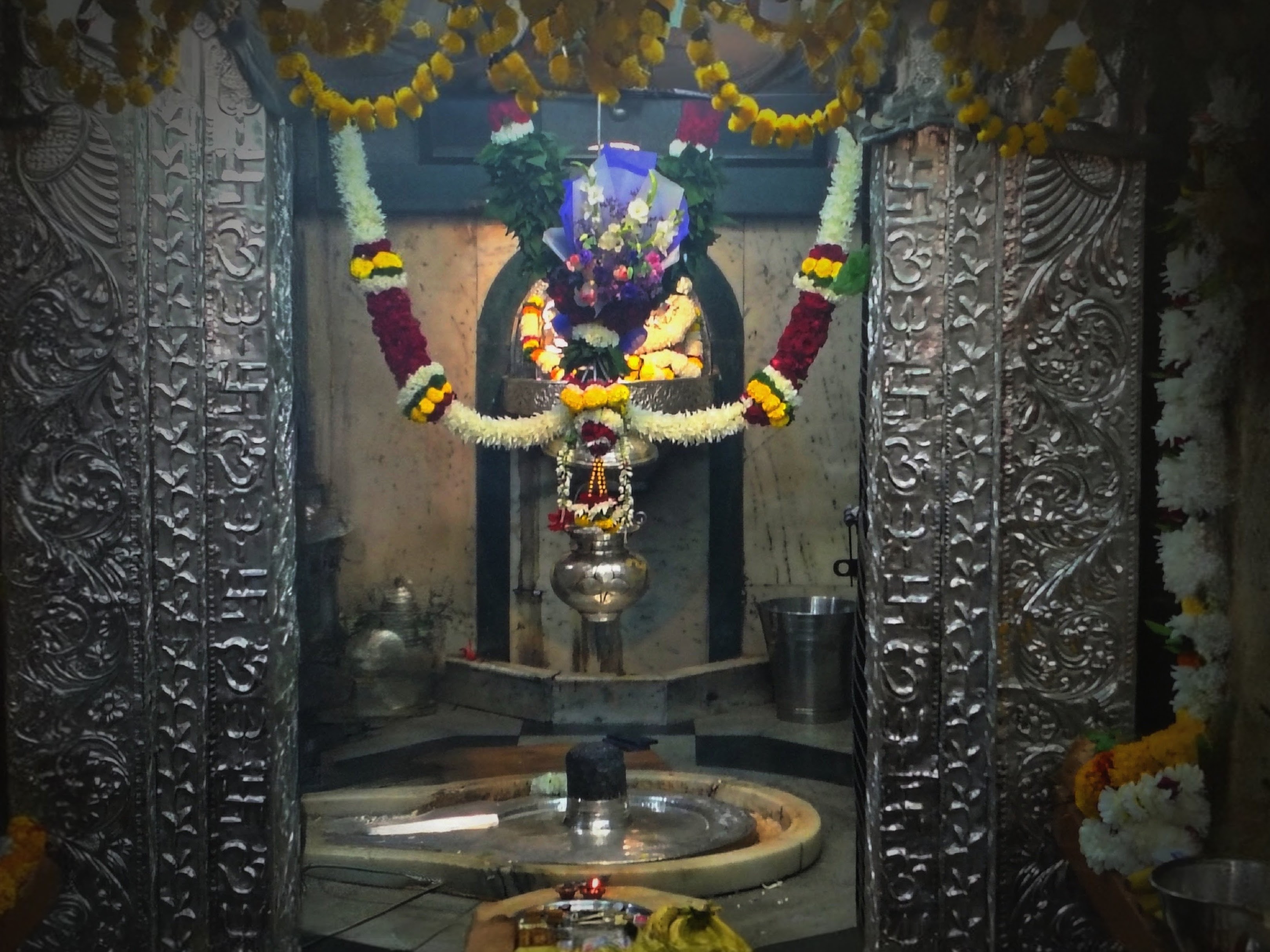
Dutondya Maruti idol, Nashik
1. Dutondya Maruti
A rare, unusual Hanuman idol near Ganga Ghat depicted with two faces ("Dutondya" means two-faced) — one of Nashik's most distinctive and photographed temple landmarks.
Photo: Virajnene95 / Wikimedia Commons, CC BY-SA 4.0
Kapaleshwar Mahadev shrine, Nashik
2. Kapaleshwar Mahadev
An ancient Shiva temple near Ramkund in Panchavati, notable among Shiva temples for having no Nandi (bull) statue at its entrance — local tradition holds this is because Shiva is believed to have cursed the bull here.
Naroshankar Mandir, Nashik
3. Naroshankar Mandir
A Shiva temple built in 1747 by Sardar Naro Shankar Rajebahaddur on the banks of the Godavari, best known for the massive bronze "Naroshankar Ghanta" (bell) that hangs at its entrance.
Photo: AnandKatgaonkar / Wikimedia Commons, Public Domain
Saptashrungi Devi Temple, Vani, Nashik
4. Saptashrungi Mata Mandir
One of the three-and-a-half Shakti Peethas of Maharashtra, this Devi temple sits atop Saptashrungi Gad hill near Vani, about 60 km from Nashik, reachable by a scenic ropeway/funicular up the hillside.
Photo: AmitUdeshi / Wikimedia Commons, CC BY-SA 3.0
Goda Ghat, Nashik
5. Goda Ghat Aarti
A daily evening Godavari Aarti ceremony performed at Goda Ghat, in the same devotional tradition as the Ganga Aarti at Haridwar and Varanasi — a peaceful, recommended way to end a day of darshan.
Photo: Prashant Kharote / Wikimedia Commons, CC BY-SA 4.0
Someshwar temple, Nashik
6. Someshwar
An ancient riverside Shiva temple on the Godavari, set beside a popular garden and boating spot — a calmer, greener stop away from the busier central ghats.
Photo: Prabirghose / Wikimedia Commons, CC BY-SA 4.0
Lord Rama statue, Tapovan, Nashik
7. Tapovan & the Ram Pratima
Tapovan, on the Godavari's bank, is traditionally believed to be where Lord Rama, Sita, and Lakshman spent part of their exile — marked today by a large Ram statue (Ram Pratima) and riverside temples.
Photo: Rangnath Wakchaure / Wikimedia Commons, Public Domain
Shri Swaminarayan Mandir, Nashik
8. Swaminarayan Mandir
A modern, ornately carved temple of the Swaminarayan Hindu sect, founded by Bhagwan Swaminarayan in Gujarat — known for intricate architecture and community cultural programs, a good stop on a broader temple-hopping itinerary.
Photo: Swapppp57 / Wikimedia Commons, CC BY-SA 4.0
Jain Mandir, Nashik
9. Jain Mandir
A prominent Jain temple in Nashik reflecting the city's multi-faith religious landscape, known for its detailed marble work and quiet, contemplative atmosphere.
Photo: Gauravghosh24 / Wikimedia Commons, CC BY-SA 3.0
Dadasaheb Phalke Smarak, Nashik
10. Dadasaheb Phalke Smarak
A memorial near the Pandavleni Caves honouring Dadasaheb Phalke, widely regarded as the father of Indian cinema — a worthwhile cultural stop for pilgrims combining faith with Nashik's heritage.
Photo: Laurawtn / Wikimedia Commons, CC BY-SA 4.0
Navsha Ganapati temple, Nashik
11. Navsha Ganapati
One of Nashik's oldest and most revered Ganesh temples, popular with locals for its long-standing tradition of granting "navas" (vows/wishes) — a well-loved stop before starting a pilgrimage.
Photo: Mahi29 / Wikimedia Commons, CC BY-SA 4.0
Want timings, entry rules, or step-by-step directions to any of these? Get detailed information in the AI chat

Have a specific question?

Our AI assistant can answer questions about Snan dates, Akharas, rituals, history and more — grounded in the same information on this page.

Ask AI Kumbh
AI Assistant
Travel · Online
Conversation
Live Results
Recording